Beta-Testing Childhood Is Going to Bangkok
JAI Behavioural will present at the AI & the Future of Education Conference, 31 October to 1 November 2026.

Some news.
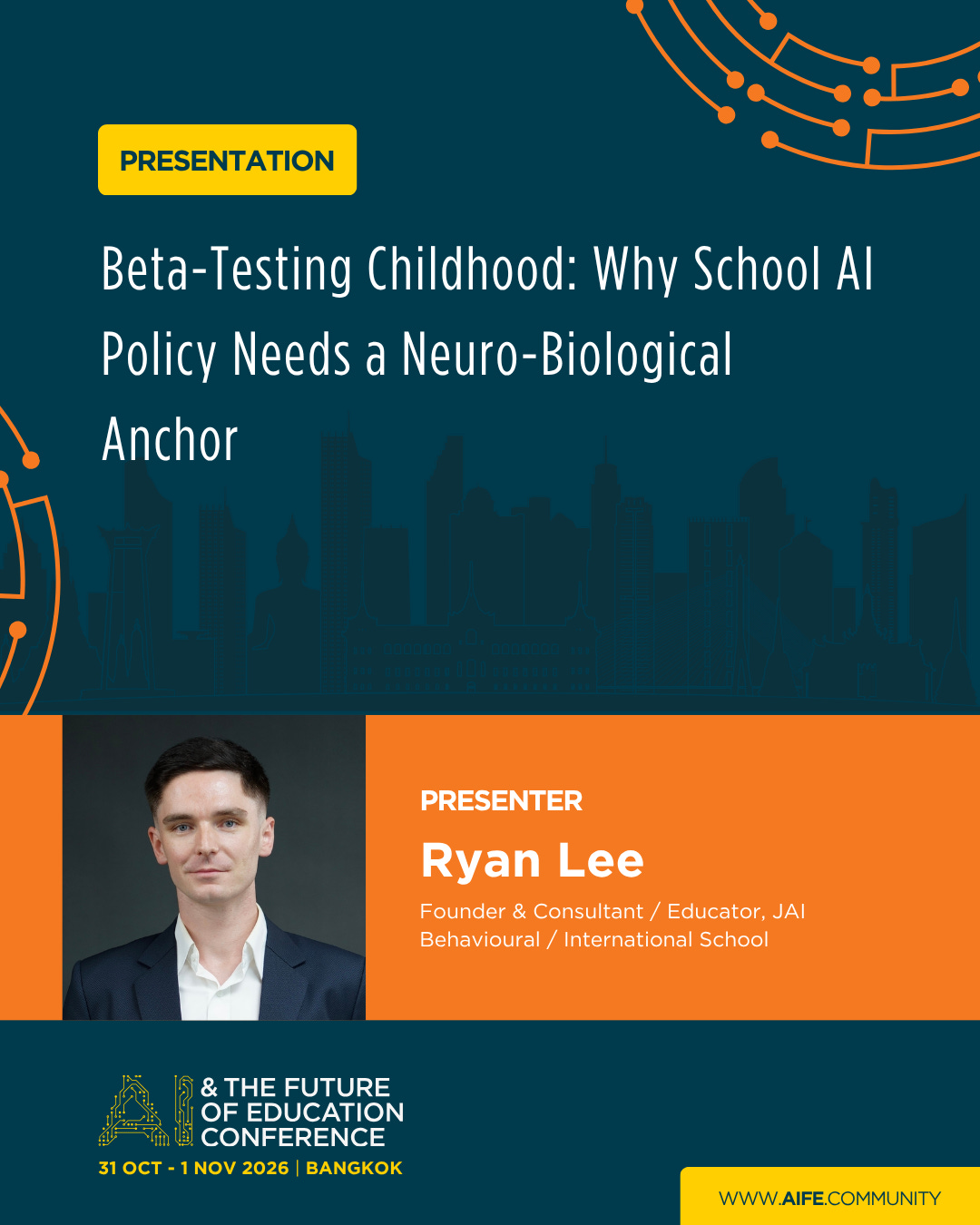
This October, I’ll be facilitating a Think Tank session at the AI & the Future of Education Conference (AIFE) in Bangkok: “Beta-Testing Childhood: Why School AI Policy Needs a Neuro-Biological Anchor.”
If you’ve been reading this Substack, you’ll recognise the title. Beta Testing Childhood started as an essay arguing that schools are running an uncontrolled experiment on developing brains: deploying generative AI into classrooms during the most sensitive windows of executive function development, with no framework for asking whether the cognitive effort being displaced was effort children actually needed to spend.
Tech Policy Press published it. Now it’s a conference session. And the argument has sharpened considerably since the original piece, because in March we went and counted.
What the audit found
In March 2026, I conducted a systematic audit of 14 major international accreditation bodies, including CIS, IB, and COBIS, and 50 leading international schools.
The results:
100% of major accreditors have no mandatory AI governance framework. Not weak frameworks. Not voluntary guidance with teeth. None.
92% of the schools we investigated have no publicly visible AI governance policy at all.
This is the Governance Vacuum. It’s not a metaphor. It’s a measured absence, and it sits directly on top of the developmental window (roughly ages 3 to 12) when executive function is being built through exactly the kind of effortful cognition that AI tools are designed to remove.
Most school AI policy, where it exists, is plagiarism policy wearing a governance costume. It asks whether the student cheated. It does not ask what the tool is doing to the cognitive architecture of a seven-year-old. Those are different questions, and only one of them has anything to do with how brains develop.
From vacuum to framework
I wanted to start building an alternative: an age-banded framework for generative AI use across the compulsory education range, grounded in what the developmental neuroscience and learning-science literature actually supports, and honest about what it doesn’t.
The short version runs in four bands:
Ages 3 to 6: no generative AI exposure in educational settings. This is when the foundations of inhibitory control, working memory, and cognitive flexibility are being laid down (Diamond, 2013; Best & Miller, 2010). The evidence base for generative AI in this age group is, in practical terms, empty. The restriction reflects the absence of data, not a moral panic.
Ages 7 to 10: AI literacy through observation and explanation, not personal use. Children learn what AI is, how it works, and why its output sometimes looks right but is wrong. They do not use it to complete schoolwork, because this is the period when retrieval practice and the generation effect are most needed and most easily bypassed.
Ages 10 to 13: narrow, supervised, task-specific use that preserves student retrieval and generation. The model here is the guardrailed tutor configuration in Bastani et al. (2025): hints, not answers. The same study showed unrestricted access produced a 17% performance deficit once the tool was removed.
Ages 13+: supervised independence within an institutional governance framework. Worth being blunt about this one: the age 13 floor adopted by UNESCO derives from data-protection law, not developmental neuroscience. It’s the band where independent use becomes defensible, not the band where it becomes unproblematic.
The framework states its own limitations openly. It has not been validated as an intervention. The band boundaries are pragmatic groupings, not neural thresholds. And the evidence base is asymmetric: strongest for adolescents, most reliant on inference for the youngest children. A longitudinal study designed to close exactly those gaps is currently being prepared for ethics submission at King’s College London.
That honesty is the point. School leaders are drowning in vendor certainty. What they need is a defensible position with the reasoning shown.
What the session covers
The Bangkok session is a facilitated 30-minute Think Tank for school leaders and coordinators. We’ll move past the comfortable “this is just the internet revolution again” analogy (it isn’t; the internet didn’t volunteer to do your thinking for you) and examine AI as a potential cognitive surrogate.
I’ll be introducing the Neuro-Behavioural Governance Model (NBGM), the framework JAI Behavioural has developed to fill the vacuum, built on two principles:
Informed Delay: the deliberate, evidence-based sequencing of AI exposure against neurodevelopmental milestones, rather than deployment at the speed of procurement.
Cognitive Guardrails: age-stratified constraints that protect the effortful cognition developing brains need, instead of treating all “engagement” as a win.
Attendees will leave able to identify the Governance-Development Gap in their own institution, define Cognitive Effort Displacement and what it means for primary-aged learners, and explore the NBGM audit process for evaluating their school’s AI governance against actual neuro-biological milestones rather than vendor promises.
Why this matters beyond one session
Schools are not waiting for the evidence base to mature. The EU AI Act’s high-risk education provisions don’t bite until December 2027. Accreditors aren’t asking the question. Which means right now, the only thing standing between a developing brain and an unexamined deployment decision is the judgement of individual school leaders, who are mostly being advised by the companies selling them the tools.
The session is designed for exactly those leaders: the ones who want to move from reactive plagiarism policies to proactive, neuro-informed governance that treats student cognitive health as a non-negotiable institutional mandate.
If you lead an international school and you’ll be at AIFE Bangkok, come and argue with me. That’s what a Think Tank is for.
AI & the Future of Education Conference 31 October to 1 November 2026, Bangkok Session details: aife.community
Ryan Lee is the founder of JAI Behavioural and an MSc candidate in Psychology and Neuroscience of Mental Health at King’s College London. For the full age-banded framework or a governance consultation, contact ryan@jaibehavioural.com.